DPA: A one-stop metric to measure bias amplification in classification datasets

*Equal Contribution
School of Computing and Augmented Intelligence, Arizona State University, Tempe, AZ, USA

NeurIPS 2025

Mars-Bench Tasks: Classification, Segmentation, and Object Detection

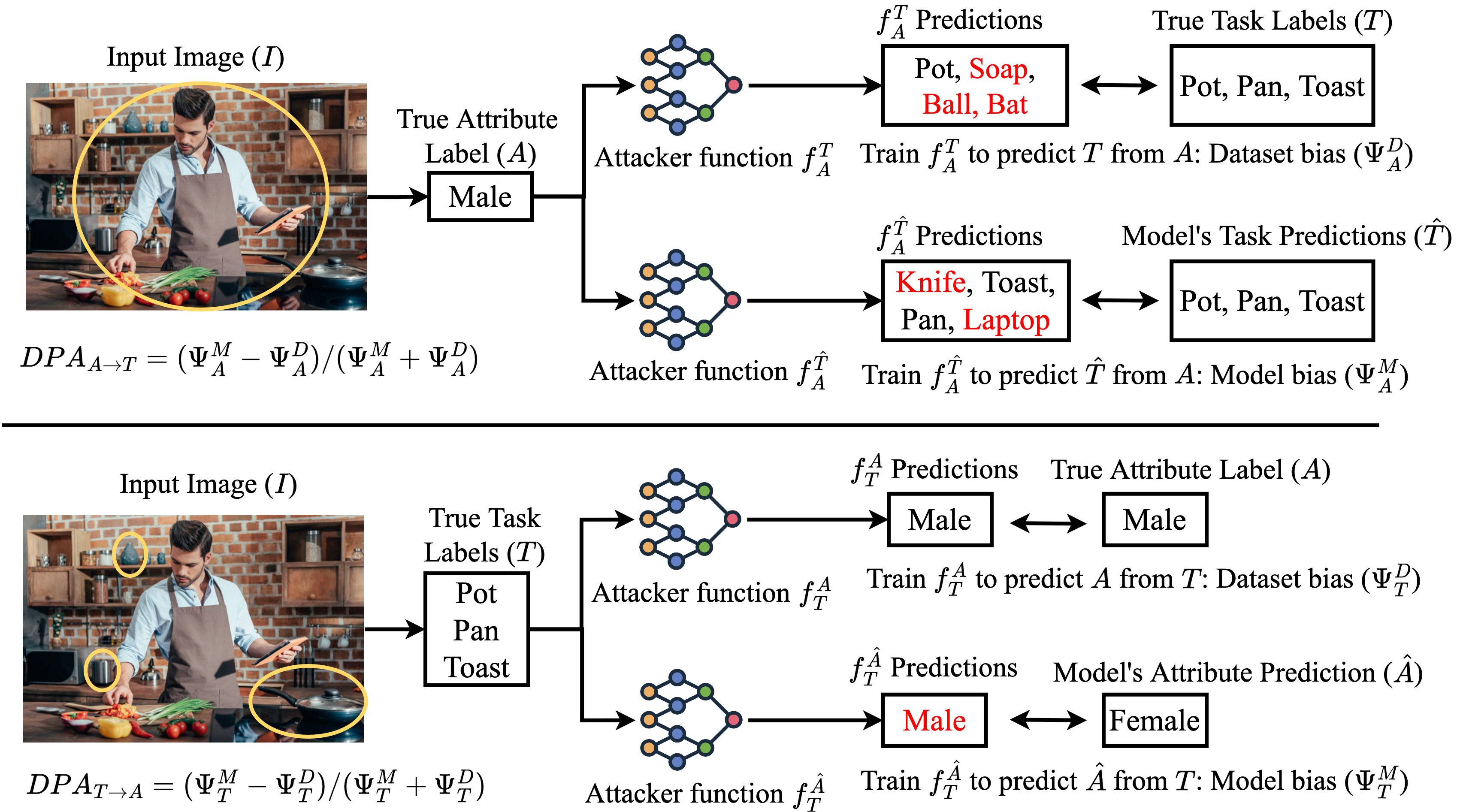
Estimating bias amplification using DPA.

Abstract

Most ML datasets today contain biases. When we train models on these datasets, they often not only learn these biases but can worsen them --- a phenomenon known as bias amplification. Several co-occurrence-based metrics have been proposed to measure bias amplification in classification datasets. They measure bias amplification between a protected attribute (e.g., gender) and a task (e.g., cooking). These metrics also support fine-grained bias analysis by identifying the direction in which a model amplifies biases. However, co-occurrence-based metrics have limitations --- some fail to measure bias amplification in balanced datasets, while others fail to measure negative bias amplification. To solve these issues, recent work proposed a predictability-based metric called leakage amplification (LA). However, LA cannot identify the direction in which a model amplifies biases. We propose Directional Predictability Amplification (DPA), a predictability-based metric that is (1) directional, (2) works with balanced and unbalanced datasets, and (3) correctly identifies positive and negative bias amplification. DPA eliminates the need to evaluate models on multiple metrics to verify these three aspects. DPA also improves over prior predictability-based metrics like LA: it is less sensitive to the choice of attacker function (a hyperparameter in predictability-based metrics), reports scores within a bounded range, and accounts for dataset bias by measuring relative changes in predictability. Our experiments on well-known datasets like COMPAS (a tabular dataset), COCO, and ImSitu (image datasets) show that DPA is the most reliable metric to measure bias amplification in classification problems.
What is Bias Amplification?

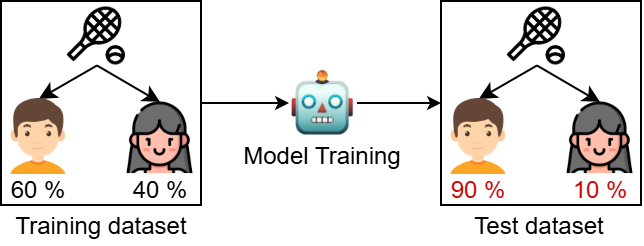
Bias Amplification Overview

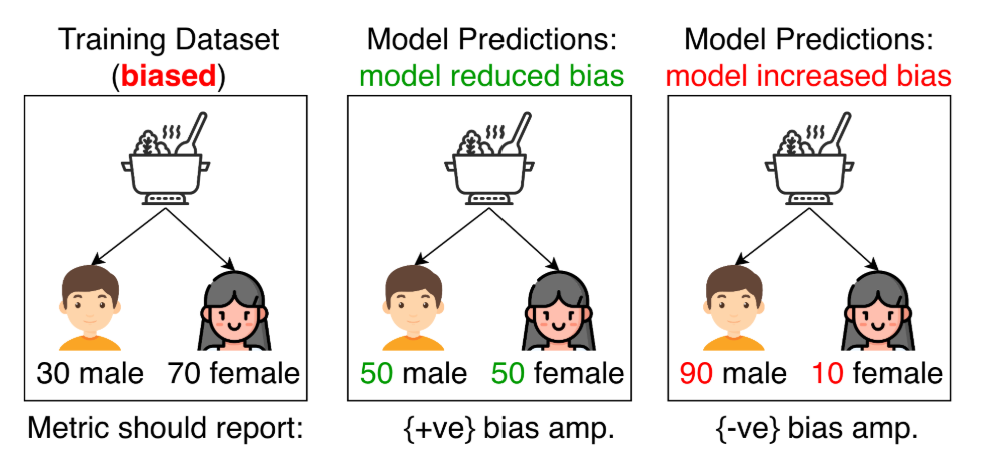
Bias Amplification: Model "worsens" the existing 60:40 in the training data to 90:10 in the predictions.

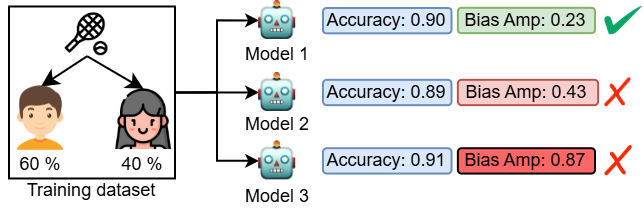
Rashomon Effect Overview

For models with similar overall accuracy, different models can amplify bias to different extents (Rashomon Effect). Bias amplification metrics can help identify models that amplify bias the least.

Desirable Properties

Directionality

Directionality

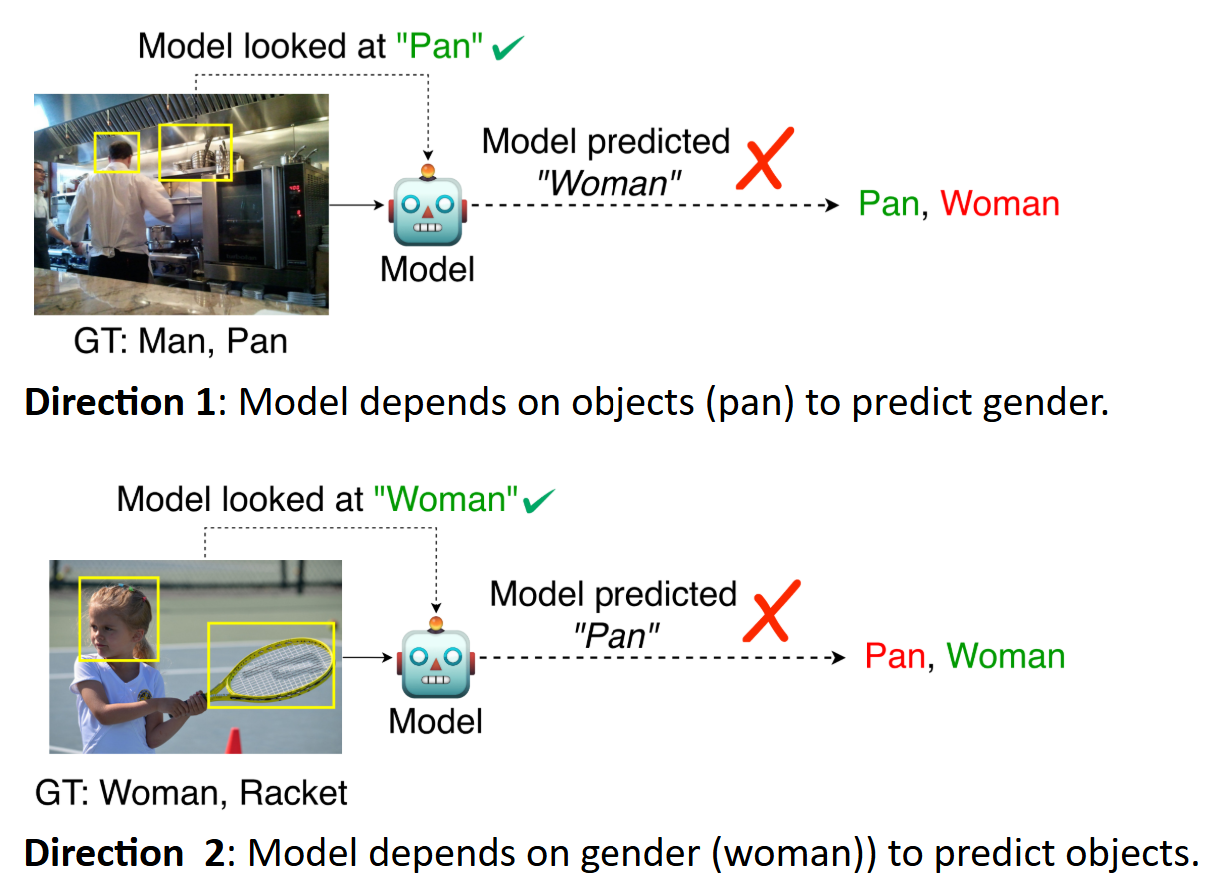
Property 1: Directionality - DPA can identify the direction in which a model amplifies bias, unlike prior predictability-based metrics.


Sign-Awareness

Sign-Awareness

DPA is sign-aware: it can measure both positive and negative bias amplification, unlike some co-occurrence-based metrics.


Balanced Datasets

Balanced Datasets

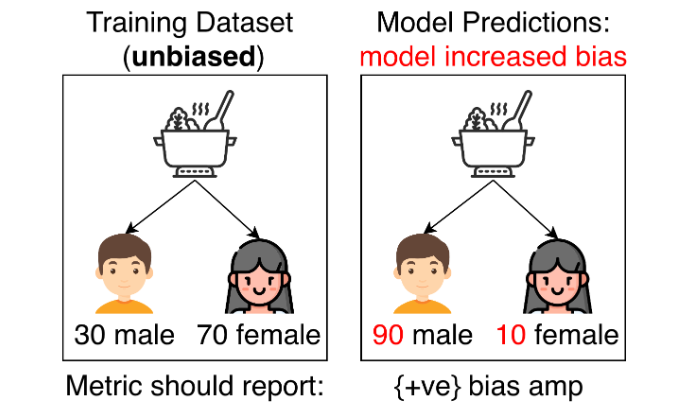
DPA works correctly even on balanced datasets, unlike some co-occurrence-based metrics.


Experimental Results

Directionality Experiment

Directionality_Experiment

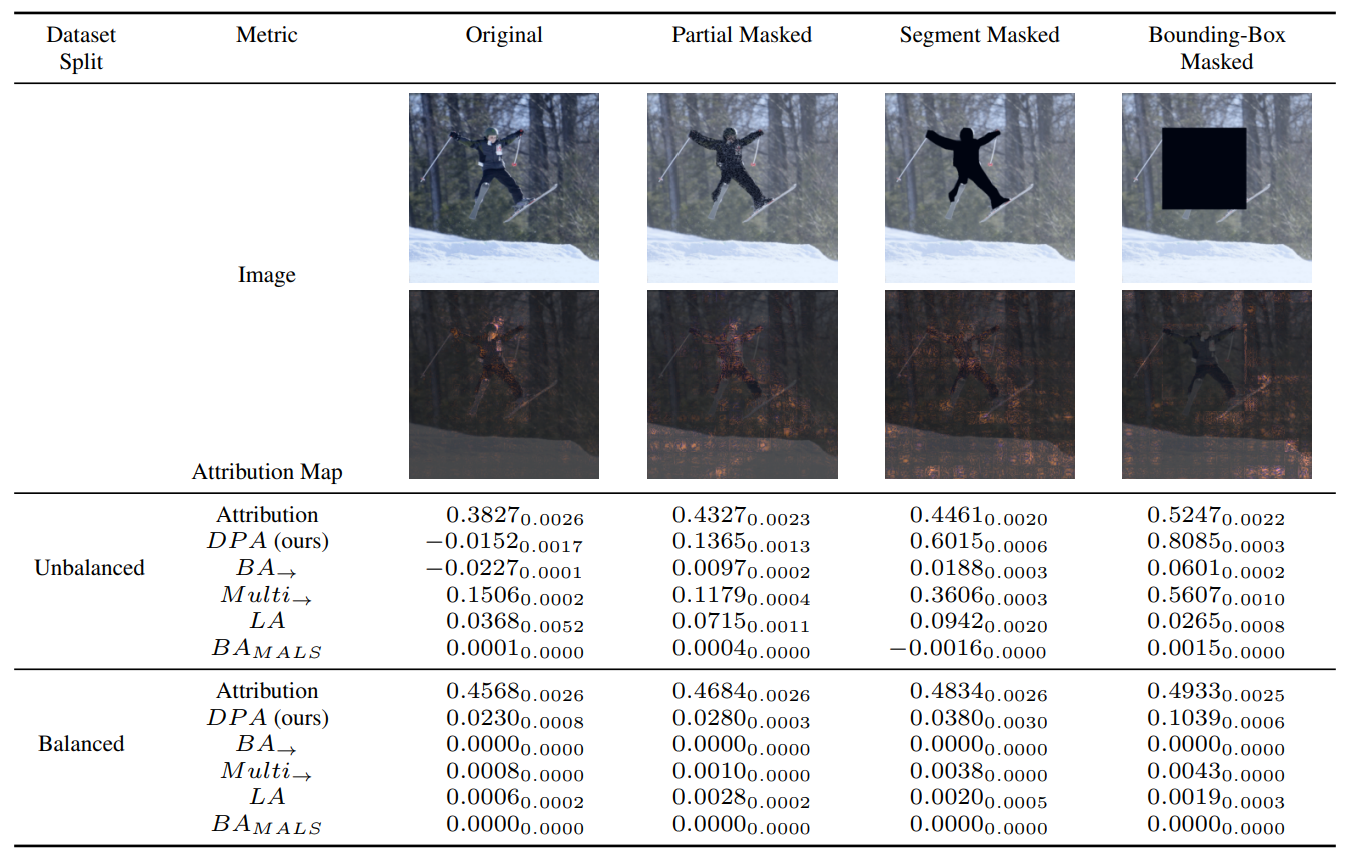
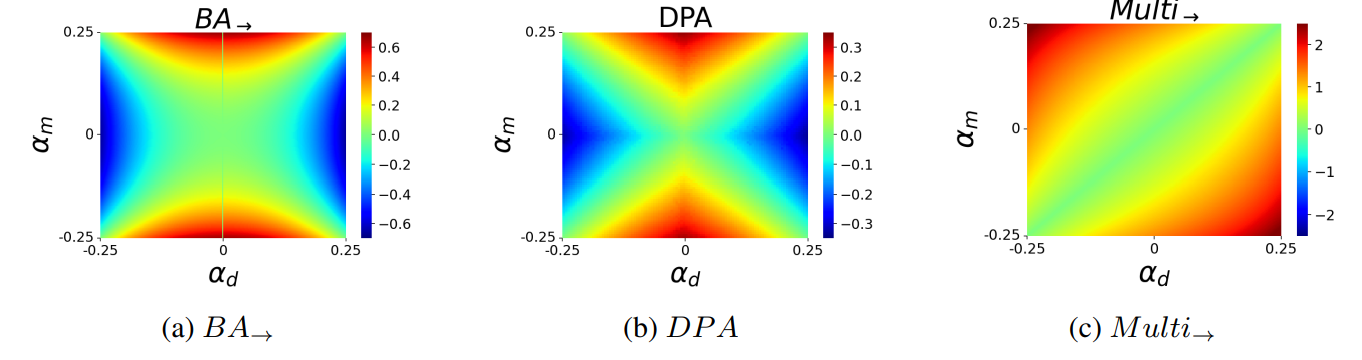
Among all metrics, only DPA shows an increase in bias for both unbalanced and balanced datasets — DPA is the only reliable metric.


Behavior in Controlled Experiment

Behavior of different metrics in controlled experiment

Caption TBA.


Acknowledgment

We acknowledge the Research Computing at Arizona State University for providing HPC resources that have contributed to the results reported in this paper. We also thank Mirali Purohit for her helpful suggestions throughout the development of this work.

BibTeX

TBA